Tuesday, October 1, 2013

Glass features and uses

Glass is both a transparent or translucent material that can have different texture and colors.

  • It is waterproof, smooth and hard, but, at the same time, fragile.
  • It is resistant to environmental conditions and to chemical compounds.
  • It is a good thermal, electrical and acoustic insulator.

Glass is made by mixing sand, soda and limestone. This mixture is heated to 1400ÂșC. When the mixture reaches this temperature it melts to form a paste.


Depending on the objects we can make we use different techniques.
We use blow moulding process to make bottles, test tubes, decanters, drinking glasses, etc.
If we can make windows glasses or plates we have to use float glass process We must use the lamination process if we can obtain laminated glass. This type of glass is often used to make windows with hacking, heat and noise protection; bulletproof glass is also one of types of laminated glass.


Binders in construction

Binders are materials used to join together other materials.

We can use many types of binders for building:

Plaster: It is made from crushed gypsum. It is used to make archways, partitions and as covering for walls.


Cement: It is a grey powder made from a mixture of limestone, clay and gypsum.


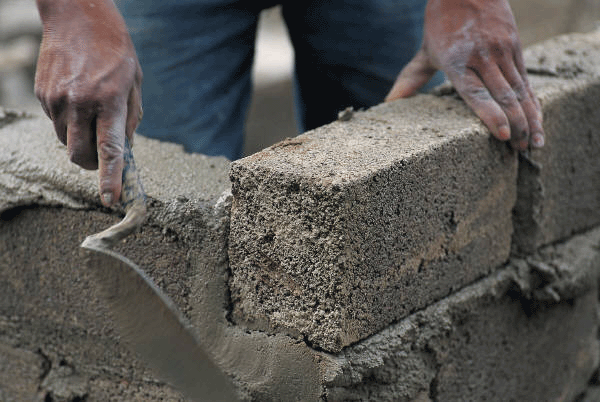
Mortar: It is a mixture made from cement, sand and water. It is used to hold together construction materials like bricks or paving stones.


Concrete: it is a mixture of gravel, sand, cement and water. When it dries it hardens forming a strong material. It is used to make foundations, beams, columns, arches, etc.


Types of stones for building

Stones are materials found in nature as large blocks of rock within the earth. For example, marble, granite, and slate. We can obtain them from quarries.


We can also find them in different sized granules and fragments, such as sand and gravel.


Marble and granite have high density and high resistance to environmental conditions. They are used on floor and walls.


Slate is hard, dense and compact which makes it waterproof. It is mainly used to cover roofs and as paving stones.


Sand and gravel are used to make asphalt (a mixture of tar, sand and gravel).


Generating electricity

Where does electricity comes from?

Electricity is a very useful form of energy. It comes from special factories called power stations.

  • In most power stations the following steps are necessary:
  1.  The fuel is burned to release heat energy.
  2.  This energy is then used to heat water (in the boiler), changing it into steam.
  3.  The steam is then used to turn the turbine.
  4.  The turbine turns the generator which produces electricity.
  5.  The electrical energy produced travels through wires to houses, shops and factories.
  6.  Machines called transformers change the voltage of the electricity travelling along the wires.

The energy changes in this process are:
Chemical energy → heat energy → kinetic energy → electrical energy

  • In a hydroelectric power station there are no boilers. The kinetic energy of the falling water is transformed directly into the kinetic energy of the turbine blades.

The energy changes in this process are:
Gravitational potential energy → kinetic energy of water→ kinetic energy of turbine→ electrical energy

Paying for your electricity

The electrical energy from a power station travels along a network of wires called the National Grid to our homes. There it passes through an “electricity meter” for measuring the electrical energy we use. The meter measures this energy in kilowatt-hours (kWh). Every two months we receive a bill for the electrical energy consumed.


Most appliances in our homes need electrical energy to work, but they use the energy in a different way. Some, like electric heaters, use the energy quickly. Others, like light bulbs, use the electrical energy much more slowly. The rate at which energy is being used is called the power of the appliance. We measure the power in watts (W) or kilowatts (kW). One kW is 1000 W.

The power of some common domestic appliances is: